

The Zambakari Advisory
  • About
  • Services
    • Strategic Intelligence
    • Program Design
    • Transitional Processes
  • Publications
    • Africa >
      • Special Issue: Spring 2023
      • Special Issue: Fall 2021
      • Special Issue: Fall 2020
      • Special Issue: Summer 2020
      • Special Issue: Spring 2020
      • Special Issue: 2019
      • Peer Reviewed Articles
      • Reports
      • Magazines/Newspaper
      • Policy Brief
      • Features
      • Book / Book Chapter
    • Middle East & North Africa >
      • Special Issue: Spring 2023
      • Special Issue: Winter 2020
      • Peer Reviewed Articles
    • North America >
      • Special Issue: Summer 2023
      • Special Issue: Spring 2023
      • Special Issue: Fall 2021
      • Special Issue: Fall 2020
      • Peer Reviewed Articles
      • Reports
    • Call For Papers >
      • Special Issue Spring 2023
      • Special Issue Winter 2023
  • Blog
    • Africa
    • Middle East
    • North America
    • Submission Guidelines
  • Media
  • Donate

The Reversal Of African Democracy¹

10/14/2017

0 Comments

 
Hermann-Habib Kibangou²
Picture
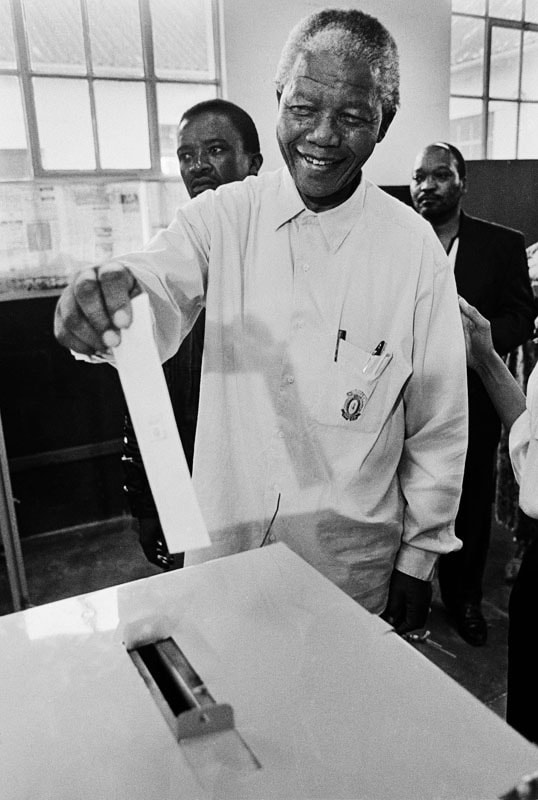
Official Photo of Nelson Mandela voting the first time in his life in the general elections held in South Africa on April 27, 1994. (Source: Wikimedia Commons)
The numerous disputes over the outcome of the elections in Africa and the ensuing conflicts about the rejection of the results by one of the candidates of the presidential elections, call into question the sincerity of the proponents of power to work for the development of their respective peoples. Will Africa have its own version of democracy? By this term we mean a type of democracy that opposes the general interest to the partisan and ethnic interest of African citizens, a democracy that ignores Human Rights, etc. ​

Following the recent post-electoral socio-political situation in Gambia, there is a constant debate over African democracy, about how some leaders would end up. If they knew they would either be chased from power like Mobutu from former Zaïre (now Democratic Republic of Congo),³  killed like Samuel Doe of Liberia, or Mouammar Khadafi of Libya, many African Presidents would give up. Better, if one said that politics in Africa makes someone crazy, makes someone lose his head and therefore the capacity to reason, no doubt very few would venture there.
The meaning of "African democracy"

Cameroonian historian Achille Mbembe, remarked that in Africa, "the exit of authoritarianism is thwarted by the social crisis and the unpreparedness of the elites."⁴ This reflection raised a still topical debate on the articulation of the universal values of democracy, from one side, and African values and cultures, from the other side. More than a decade later, Togolese lawyer Bileou Sakpane-Gbati took over in one of his articles. According to him, "At the school of democracy, African states have the sad reputation of being bad students. Building a genuine democracy is undermined by the persistence of tribal or ethnic considerations. It is therefore important to rethink democracy in Africa by first breaking away from the myth that, because of their traditional organizations, African societies are incompatible with democracy.⁵ These analyses made by Bileou Sakpane-Gbati, says Jean-Didier Boukongou⁶ are rejected by the thurifera of the African model of democracy.  Given the controversial political realities on the continent, is it possible to promote an African model of democracy in Africa that is peculiar to Africans, even if the methods seem at first sight to be anti-democratic?"⁷, he asks.
The language of lies
​

To answer the question raised by Boukongou⁸ and the question about African democracy, two observations are necessary. The first is that the problem of intellectuals is words. What understanding do we have of the words we use? When we talk about democracy, what do we want to say? The second observation concerns the lexicon used. In political life, we use two dictionaries, if not three: the dictionary of truth and that of lies, sometimes the third, which is the mixture of that of the first two. If, in everyday life, a Head of State is labeled as a tyrant or dictator, he would not recognize himself as such in the realm of power. These two observations would almost give this: history has an elephant's memory, but some politicians, and those who support them, have a hard head. They easily forget the many lessons of history.⁹ Why do they think that what happened to others would not happen to them? Hence the question: does power transform its holder into an animal, to the point of wanting to sacrifice with pertinacity human lives? Historical examples reinforce this, while others prove the contrary. The leaders of the first group are those who exercise unlimited power. Called "supreme chiefs", "immortals", "lions", "elephants", "great masters", "gods", they call themselves democrats and they are democrats “in an African way". African democracy, therefore, would, as Jean-Didier Boukongou put it, be thought of as a "democracy without virtues"¹⁰​​ which can easily tilt towards tyranny. "A democracy of partisan and ethnic interests", a "democracy that turns its back on the protection of human rights", which hardly escapes the law of the strongest. But in West Africa, this "African democracy" seems to be contradicted by the alternation to power in some countries. In central Africa, however, we are still at speeches whose vocabulary is directly borrowed from the dictionary of lies¹¹​.
Picture
(Source: "Elections For Security In Africa," Africa Center For Strategic Studies)
The principle of respect for constitutional provisions

For lovers of the French game “Jeu de Dames”, one would think of the version "who loses wins"¹². Is this African democracy? Those in power have to answer with concrete and edifying examples. In such a case, one must have the courage to integrate into our Constitutions the right to cheat, the right to theft, the right to co-optation, the right to lie. If all this is done, our African elections would hardly be denounced; the winners would be elected without social tension, or any contestation; injustice will give way to justice. But as long as the dictionary of falsehood borrows its words from the lexicon of truth, it is to be feared that we will still be in the midst of these divisions which will only delay the development we wish for our countries. "What use is it for man to win the world if he should lose his soul?"¹³ This sentence can be paraphrased in the following words: "What use is it for man to take power if in the end he would end up losing his reason, even his soul?" Jean-Didier Boukongou, through his article highlights the conditions of a true democracy for Africa: the refusal of cultural bargaining of democracy, the rejection of an African democracy without universal virtues, the non- acceptance of the parodies of democracy to the African one and finally the renunciation of the African pseudo-values¹⁴. A democracy that goes against these principles would unquestionably resemble the game "Qui perd gagne (the loser wins)”¹⁵. Once African leaders accepte the results of the real ballot boxes, not those of stuffed ballot boxes, then there will be democracy. As long as these rulers leave power only under threat of military forces, it will be difficult to have a strong cultural democracy in Africa.

It is also up to the citizens to translate into reality the use of the dictionary of justice, peace, fair play, courage and sincerity. It is only under these conditions that African political life will no longer borrow its vocabulary from the "loser wins" perspective (the fact that those in power, usually dictators, reject the results of the elections and are tempted to remain in power by force; ignoring the choice made by the majority of the population). Fortunately, democracy in Africa also offers us edifying examples where the real losers refuse to yield to the temptation of the "loser wins" one. Those at least know that power and honors are at the service of the people and not at the service of the false. Barack Obama, who left power (after two well-deserved terms, recalled in his speech in Accra: "History is on the side of these courageous Africans, not in the camp of those who use coup d’états or modify the Constitutions to remain in power. Africa does not need strong men but strong institutions.”
References ​

¹ This article is inspired by the recent Presidential Election in Gambia where the former President Yaya Jameh accepted the results of the Elections before rejecting them. It was published in French in
Chad and Culture Number 354 - February 2017)

² Hermann-Habib KIBANGOU is a Research Officer at Centre d’Etudes et de Formation pour le Developpement (CEFOD) in N’djamena (Chad)
​

³ In Africa, some presidents have been chased from power like Ange-Félix Patassé and François Bozizé for CAR. Others killed like Ibrahim Barré Maïnasara of Niger, Thomas Sankara of Burkina Faso, Marien Ngouabi of Congo
​

⁴ Achille Mbembe, “Esquisses d’une démocratie à l’africaine”. Le Monde diplomatique, Octobre 2000.

⁵ This quote has been translated from French into English. See Sakpane-Gbati, “Démocratie à l’africaine”. (Ethique Publique Public Ethics), [Online], Vol. 13, number 2/2011)

​
⁶ A Congolese (Congo-Brazzaville) expert in International Law (PhD).

⁷ Jean-Didier Boukongou, « Démocratie sans vertus ». No reference.

⁸ ​Jean-Didier Boukongou, « Démocratie sans vertus ». No reference.

⁹ ​We have in mind the different Presidents who by refusing to resign, or in situations of conflict, finished whether chased or killed. Some of them were considered as dictators.

¹⁰ Jean-Didier Boukongou wrote an article entitled: « Démocratie sans vertus », in English « Democraty without virtues ». Boukongou owns a PHD in International Law and is the founder of APDHAC (Association pour la Promotion des Droits de l’Homme en Afrique Centrale) at the Catholic University of Central Africa (UCAC) in Yaoundé (Cameroon). The MacMillan English Dictionary describes virtue as “a good quality or habit that a person has, especially a moral one, such as honesty or loyalty.”

¹¹ ​Firstly, the dictionary of lies make people not to respect the Constitution and secondly, they want to remain in power even when they are not legitimately elected. The recent elections in Congo-Brazzaville, Chad and Gabon reflect this situation. According to me, the dictionary of lies is measured by the respect of the Constitution in every country and the capacity to respect the results of the Elections. There are also situations when we notice that dead people have cards to vote in a village, young men who don’t have the age to vote, do so. Or, the number of the people who have voted is superior to the number of the people who are allowed to vote (age).

¹² In French « Qui perd, gagne ».

¹³ Matthew 16:26 (English Standard Version). Oct. 13, 2017. Accessed from Bible Hub<http://biblehub.com/matthew/16-26.htm>

¹⁴  Jean-Didier Boukongou, « Démocratie sans vertus ».

¹⁵ Part of the problem is that those who crave power don’t really care about values or virtues the same way I suspect most of us do, which is part of the reason the strength of the institutions is so important.


Works Cited

Mbembe, Achille. 2000“Esquisses d’une démocratie à l’africaine”. In Le Monde diplomatique, Octobre 2000.

Sakpane-Gbati, Bileou. 2011. “Démocratie à l’africaine”. In Ethique Publique, [Online], Vol. 13, number 2/2011)

​
Jean-Didier Boukongou, Démocratie sans vertus. No reference.
0 Comments

Your comment will be posted after it is approved.


Leave a Reply.

    Be our guest.
    ​Interested in being featured on our blog?

    ​We'd love to hear from you. Find out more. 

    Archives

    October 2023
    September 2023
    July 2023
    June 2023
    May 2023
    December 2019
    October 2019
    August 2019
    July 2019
    June 2019
    February 2019
    November 2018
    October 2018
    August 2018
    February 2018
    January 2018
    October 2017
    June 2017
    May 2017
    April 2017
    March 2017
    January 2017
    July 2016
    June 2016
    April 2016
    March 2016

    Categories

    All
    Abubakar Shekau
    Advocacy
    Africa
    African Union And Sudan
    Alfred Marshall
    Al Shabaab
    And Dementia
    And Dementia: Healthy Aging In Arizona Aging Population In Arizona Advocacy For Seniors Medical Technology For Seniors Baby Boomers And Health Hospice Care For Seniors Dementia And Alzheimer's Disease Senior Health And Wellness Preventative Healthcare Fo
    And Senior Living Options: Assisted Living In Arizona Senior Living In Arizona Desert Haven Home Care Apollo Residential Assisted Living Prescott Valley Senior Living Villa Fiore Senior Living Oasis Of Prescott Assisted Living Group Homes For Seniors Res
    And Senior Living Options. ChatGPT Here Are Some High-impact SEO Key Terms With High Searchability For Your Special Issue On Healthy Aging In Arizona
    And Senior Living Options: Healthy Aging Tips Aging Population Statistics Advocacy Groups For Seniors Medical Technology Advancements For Seniors Baby Boomer Health Concerns Hospice Care Benefits Dementia Diagnosis And Treatment Assisted Living Facilitie
    Apollo Residential Assisted Living
    AQIM
    Arab League And Sudan
    Armed Conflict And Location Event Database (ACLED)
    Assisted Living
    Baby Boomers
    Boko Haram
    Catholic Bishop Association (CENCO)
    CEMAC
    Chad
    Civil Unrest
    Civil War
    CNS
    Conflict Resolution In Sudan
    Constitutionalism
    Dementia
    Dementia. ChatGPT Here Are Some High-impact SEO Key Terms For Your Special Issue On Healthy Aging In Arizona
    Democracy
    Democracy In Sudan
    Desert Haven Home Care
    Dichotomous Categorizations Of Mobility
    Diminishing Returns
    DRC
    "Economic And Political Turmoil"
    "Economic Crisis Impact On Migration"
    Economic Development
    Economic Growth
    Etienne Tshisekedi
    Fieldwork
    Fragile State
    Framing
    Global Migration Trajectories
    Governance And Development Strategies
    Group Home
    Homosexuality
    Hospice
    Human Rights In Sudan
    Human Trafficking
    "Individual Subjectivities In Migration"
    Instability
    Jihadism
    Khartoum Protest
    Knowledge Production
    Le Rassemblement
    Mali
    Marshall Plan
    Mauritania
    Medical Technology
    "Migration Decision Factors"
    Migration Nomenclature
    Militant
    MINUSMA
    Mobutu Sésé Seko
    Narratives
    National Migration Classifications
    National Sovereign Conference
    New Sudan
    Niger
    "Non-migration Determinants"
    Non-migration In Zimbabwe
    North Africa Crisis
    North-North Migration
    North-South Migration
    Oasis Of Prescott
    "Political Factors Affecting Migration"
    Political Factors Affecting Migration
    Political Instability
    Political Instability In Sudan
    Prescott Valley
    Protest
    Qaeda In The Islamic Maghreb
    Rassemblement Des Forces Acquises Au Changement
    Referendum
    Repression
    Research
    Riek Machar
    Sahelian Region
    Salva Kiir
    Secessionism
    Senegal
    Senior Living. ChatGPT Here Are Some Additional High-impact SEO Key Terms For Your Special Issue On Healthy Aging In Arizona
    "Sociocultural Factors In Migration"
    South-North Migration
    South-South Migration
    South Sudan
    SPLA
    SPLM
    Sudan
    Sudan Call
    Sudan Civil War
    Sudan Crisis
    Sudan Crisis Sudan Civil War Democracy In Sudan Sudan Protest African Union And Sudan Arab League And Sudan North Africa Crisis Sudanese Conflict Sudanese Politics Sudanese People Political Instability In Sudan Human Rights In Sudan Sudanese Government Su
    Sudanese Conflict
    Sudanese Government
    Sudanese Military
    Sudanese People
    Sudanese Politics
    Sudan People's Liberation Movement North (SPLM N)
    Sudan People's Liberation Movement-North (SPLM-N)
    Sudan Protest
    Terrorism
    The Conflict In Sudan: Understanding The Historical And Social Context And How To End The Violence From Darfur To Khartoum: An Overview Of The Ongoing Conflict In Sudan And Strategies For Peace Exploring The Root Causes Of Violence In Sudan And What Can B
    The Democratic Republic Of Congo
    UDPS
    Unequal Mobility Opportunities
    Union For Democracy And Social Progress
    Unlawful Retentions Of Power
    Uprising
    Villa Fiore
    Violence
    Zimbabwe
    "Zimbabwe Emigration Patterns"
    Zimbabwe Migration Trends

ABOUT

MEDIA

CONTACT US

JOB OPPORTUNITIES

Copyright © 2023 The Zambakari Advisory - ​Privacy Policy 
Our site uses cookies to improve your experience. You can control cookies by adjusting your browser or device settings.
If you continue without changing your settings, we assume that you are happy to receive all cookies.
​If not, please feel free to opt out here.

SEO by Qasim Khilji

  • About
  • Services
    • Strategic Intelligence
    • Program Design
    • Transitional Processes
  • Publications
    • Africa >
      • Special Issue: Spring 2023
      • Special Issue: Fall 2021
      • Special Issue: Fall 2020
      • Special Issue: Summer 2020
      • Special Issue: Spring 2020
      • Special Issue: 2019
      • Peer Reviewed Articles
      • Reports
      • Magazines/Newspaper
      • Policy Brief
      • Features
      • Book / Book Chapter
    • Middle East & North Africa >
      • Special Issue: Spring 2023
      • Special Issue: Winter 2020
      • Peer Reviewed Articles
    • North America >
      • Special Issue: Summer 2023
      • Special Issue: Spring 2023
      • Special Issue: Fall 2021
      • Special Issue: Fall 2020
      • Peer Reviewed Articles
      • Reports
    • Call For Papers >
      • Special Issue Spring 2023
      • Special Issue Winter 2023
  • Blog
    • Africa
    • Middle East
    • North America
    • Submission Guidelines
  • Media
  • Donate